“Leather patch” is not one material. The phrase covers at least five, and the gap between them decides whether a logo still looks sharp after two years of washing and sun or starts curling at the corners. On a hat brim or a jacket back, the patch is usually the most visible branding you will put on a garment, so the material deserves more than a passing glance. Here is what actually separates the options, how each one takes a mark, and how to match the material to a bulk order.
The four grades of genuine leather
Genuine leather is not a single quality tier; it is sorted by which layer of the hide it comes from. Full-grain is the outermost layer with its surface intact, the strongest and longest-lived, and the one that develops a patina. Its natural grain variation means no two patches look identical, which reads as premium to some buyers and inconsistent to others. Top-grain has that surface lightly sanded and refinished, trading a little durability for far more consistency from piece to piece, which is exactly why it is the common choice for batch runs of logos and text. Split, often sold simply as “genuine” leather, comes from the lower layers left after the top is separated; it is thinner, cheaper, and less durable. Bonded leather is barely a solid hide at all, being leather scraps ground up and glued to a backing, and its unknown adhesives make it both the weakest option and a poor candidate for laser work.
Faux leather, and the one line you cannot cross
Faux leather splits into two families that behave nothing alike. PU (polyurethane) is the versatile one: it accepts debossing, laser engraving, and full-color heat-transfer printing, and it holds one exact color across every unit in a run. That consistency is a real advantage for uniform branding, but PU should only be lasered after the supplier confirms the entire construction, backing and adhesives included, is free of PVC. PVC (vinyl) is the family you must never put under a laser. Heating it releases corrosive, hazardous byproducts, so it is unsafe for both the operator and the machine. The practical rule follows directly: if a supplier cannot tell you whether a “faux leather” patch is PU or PVC, treat it as not laser-safe until proven otherwise. It is worth asking the question in writing, because the same finished patch can look identical in a product photo whether the base is a laser-friendly PU or a vinyl that should never see a beam, and the difference only shows up in production.
How each material takes a mark
Decoration method and material are linked. Laser engraving burns a precise, dark impression that excels at fine text and small logos, and it works best on vegetable-tanned genuine leather, which chars to a clean dark contrast; chrome-tanned leather is a case-by-case question and should be tested before a full run. Debossing presses a heated die into the surface to leave a clean stamped recess with no color change, which is why a very dark patch, where a burned mark would barely show, is usually debossed rather than engraved. Faux PU adds the one trick genuine leather cannot match, full-color printing, so a multi-color logo that has to reproduce exactly is often easier on PU than on natural hide. As a rule, pick the decoration method first when the artwork is fussy, then choose a material that supports it cleanly, rather than committing to a hide and discovering later that your logo will not read on it.
Durability and cost, and what you are paying for
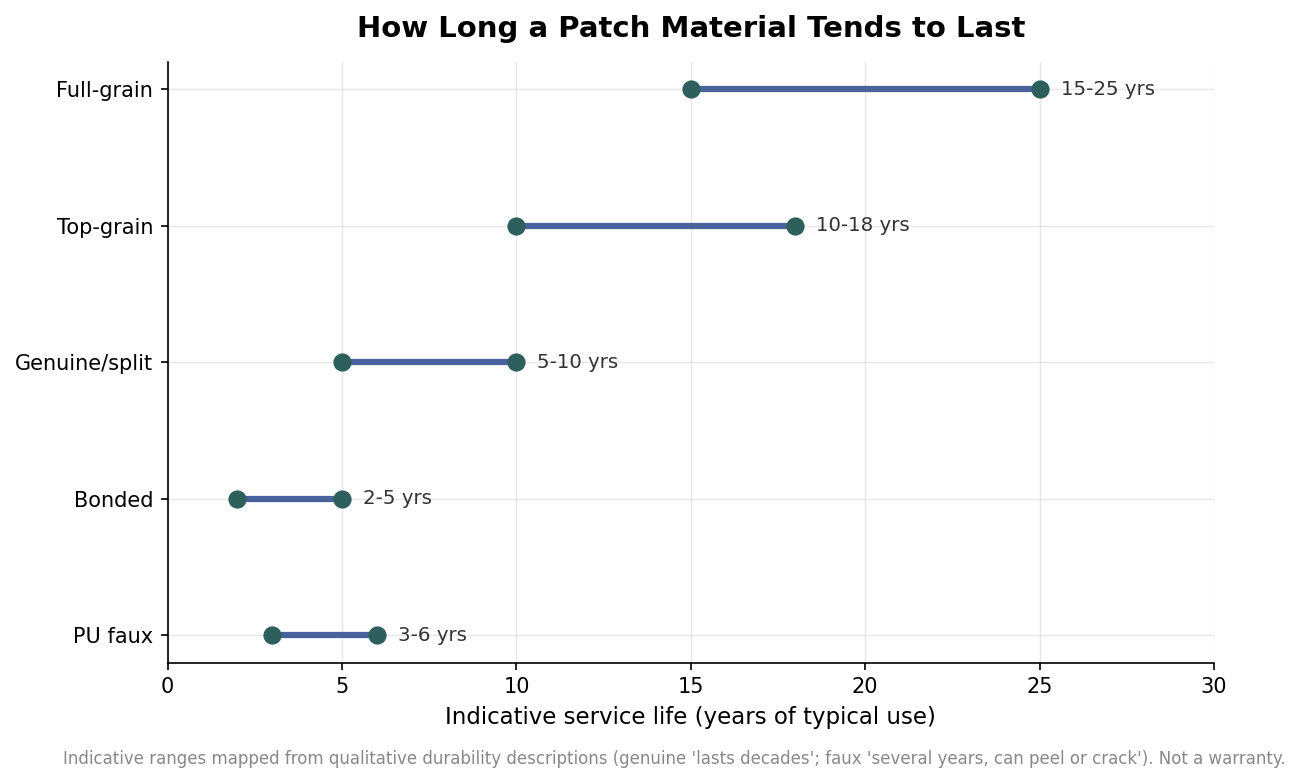
Longevity is where the grades separate most visibly. Full-grain genuine leather is described in supplier guides as lasting decades and improving with age, while faux leather is generally good for several years before the synthetic layers can peel or crack under heavy use. The chart below maps those qualitative descriptions onto indicative year ranges so the tiers are easier to compare at a glance; treat the numbers as directional rather than guaranteed.
Cost tracks durability, but not perfectly, and that is where buyers can save without hurting the product. Full-grain carries the highest unit price, top-grain sits just below it, and PU faux is the budget option with the lowest per-unit cost and perfectly uniform color. The useful insight in the next chart is that top-grain buys most of full-grain’s durability at a lower price, which is why it is so often the sweet spot for branded apparel.
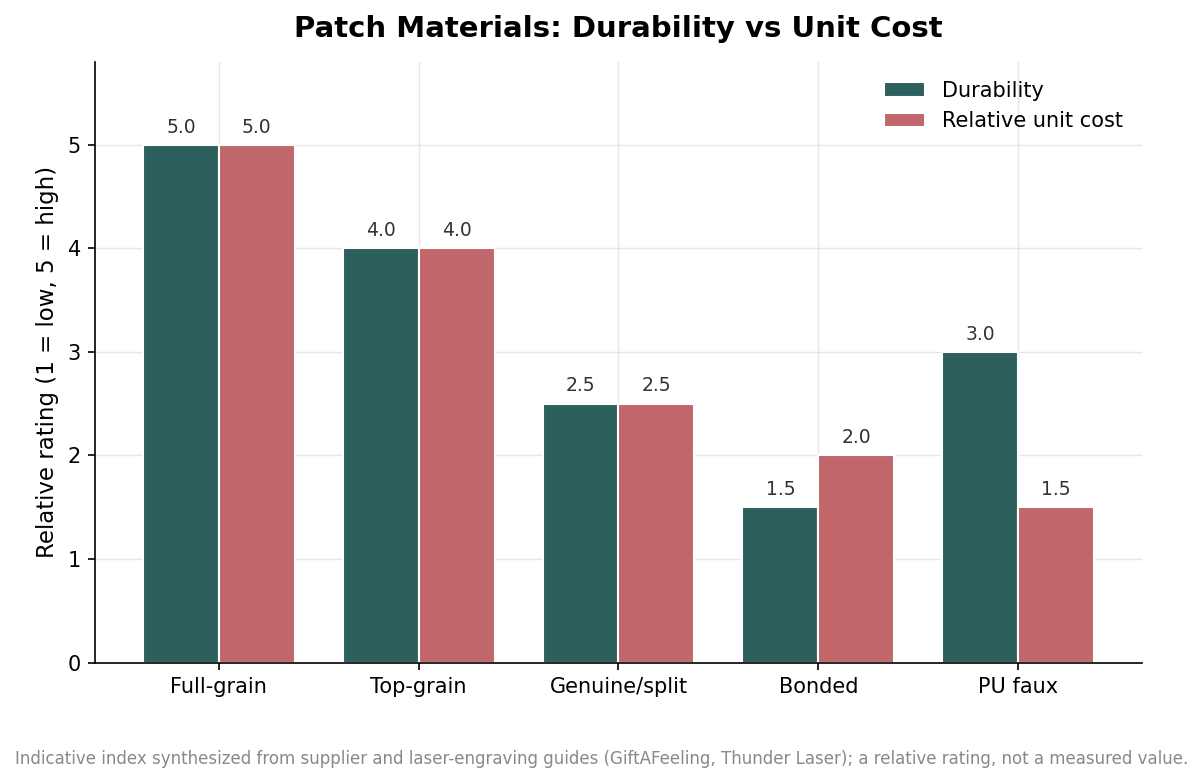
Notice that bonded leather is the trap: its cost is not the lowest, yet its durability is, so it rarely makes sense once you can see the two plotted together.
Choosing the material for a bulk order
For a run of branded hats or jackets meant to be kept and worn for years, top-grain genuine leather is the practical default, giving you near full-grain toughness with the batch-to-batch consistency a bulk order needs. Reserve full-grain for premium lines where the natural grain and patina are part of the story and a slightly higher unit cost is acceptable. Choose PU faux for giveaways, event swag, and other short-life promotional pieces where uniform color and low cost matter more than a decade of wear, and where full-color printing is a plus. Whatever you land on, patch stock is thin, commonly in the neighborhood of 2 mm, and the economics of a custom run improve as quantity climbs, since setup and tooling spread across more units and per-piece price falls; those figures are indicative and move with material, decoration method, and volume. Decide the material first, and every later decision about mark, thickness, and attachment has something reliable to sit on.