Two leather patches can carry the exact same logo and cost, wear, and read completely differently depending on how that logo was put into the leather. The decoration method is a separate decision from the leather itself, and it drives four things at once: what the mark looks like, how long it survives rubbing and washing, how much the job costs at your quantity, and whether the design even works on the leather color you chose. Four methods cover almost every custom leather patch, and the differences between them are concrete enough to choose on numbers rather than taste.
Debossing presses the logo into the grain
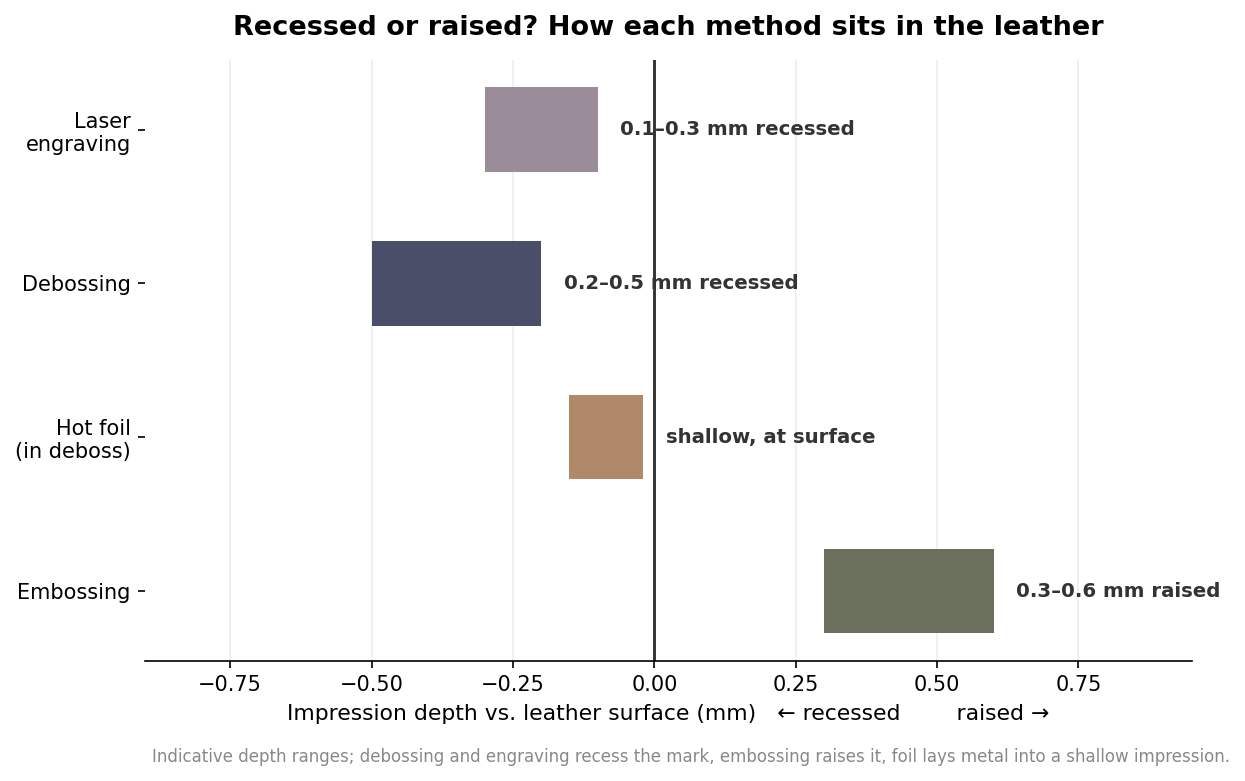
Debossing is the classic tone-on-tone look, and it is a mechanical process: a custom metal die, usually brass or magnesium, is heated to roughly 120 to 180 degrees Celsius and pressed into the leather under about two to five tons of force for a few seconds. The die does not remove any material; it compresses the fibers, leaving a recessed impression around a fifth to a half a millimeter deep that darkens naturally as the leather’s oils migrate to the pressed area. Because the grain surface stays intact, a debossed mark resists abrasion well and ages gracefully. The catch is tooling: that die is a one-time setup charge and takes a day or three to fabricate, which is cost and time you pay once before a single patch is made. On a small order that setup dominates the price; on a large one it disappears into the per-piece cost.
Laser engraving burns instead of pressing
Laser engraving reaches the same recessed look by a different road. A focused laser vaporizes the top layer of the leather to carve the design, cutting about a tenth to three-tenths of a millimeter deep with very sharp lines. The decisive advantage is that there is no die at all: the machine works straight from a digital file, so setup is under an hour and tooling cost is effectively zero. That makes engraving the natural choice for short runs, one-off names and numbers, and any job where each patch is different. It has one real limitation worth knowing before you commit, which is that engraving creates its contrast by exposing the lighter interior of the leather, so it shows up beautifully on natural tan and mid-brown hides and produces almost no contrast on leather that is dyed dark or black all the way through. If your patch has to be black, engraving is usually the wrong tool. Comparing its cost with debossing is the clearest way to see where each method belongs.
Engraving is usually the cheaper choice on small runs because it skips the die, while debossing catches up once the quantity is high enough to spread that tooling across many pieces. On short runs engraving tends to win on total cost; on large repeat runs of the same design, debossing often does. The crossover point depends on the artwork, the patch size and the leather, so ask for both methods to be quoted at your quantity.
Embossing and hot foil change the profile and the shine
The other two methods are variations on pressing. Embossing is debossing’s mirror image: instead of pushing the design down into the leather, it raises the design up off the surface, typically a third to six-tenths of a millimeter proud of the grain, using a die cut in relief. It reads as more three-dimensional and tactile, and it carries the same die cost and durability profile as debossing since it is the same press-and-die principle. Hot foil stamping adds color and shine to the equation. A heated die presses a thin metallic or pigmented foil into a shallow impression, leaving a crisp gold, silver, or colored mark with a premium, glossy finish that neither debossing nor engraving can match. The tradeoff is durability: foil sits at the surface, so on high-contact items it can fade or lift over years in a way that a recessed, ink-free debossed mark does not. Foil also needs both a die and the foil stock, so it is a tooling-cost method like debossing, best reserved for pieces where the metallic look is the point. The next chart lines up where each method actually sits relative to the leather surface.
Choosing by quantity, color, and the look you want
Put the four methods against a real job and the choice usually makes itself. Start with quantity. If you are ordering a few dozen to a few hundred patches, laser engraving avoids the die entirely and turns around fastest; if you are ordering in the thousands and want the same design every time, debossing or embossing amortize their tooling into a lower per-piece cost. Then check the leather color. Engraving needs a lighter hide to show contrast, so a dark or black patch points you toward debossing, embossing, or foil. Finally decide the look. Understated and traditional favors a recessed debossed mark; tactile and dimensional favors embossing; a premium metallic accent favors foil. Durability tracks with depth here in a useful way: the methods that physically move leather, debossing and embossing, hold up best under rubbing, while surface foil is the most vulnerable and engraving lands in between, staying sharp on sealed full-grain leather for thousands of handling cycles before it begins to lighten.
All of the figures above, such as the depths and press settings, are indicative ranges drawn from industry sources rather than fixed specifications, and they shift with the shop, the artwork’s complexity, and the specific leather. Treat them as a map of the tradeoffs, not a quote. The reliable takeaways hold regardless of the exact numbers: engraving is the low-setup choice for small and variable runs, debossing and embossing win on volume and on dark leather, and foil buys a metallic look at some cost to longevity. Match the method to your quantity, your leather color, and the finish you are after, and the same logo will land exactly the way you intended.